Sunday, August 25, 2013

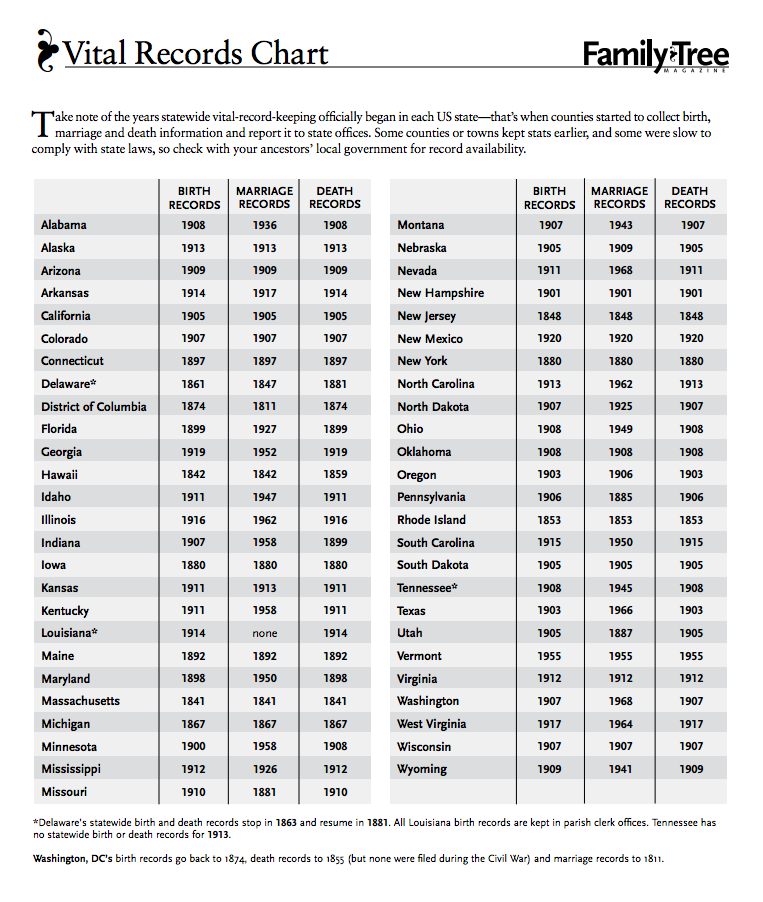
Family Tree Magazine's free Vital Records chart

Family Tree Magazine Vital Records Chart
Vital records are records of life events kept by the authority of a government. Birth certificates, marriage licenses, and death certificates are all considered vital records, and are excellent sources of information about our ancestors' lives. Each US state has laws governing the way vital records are collected and preserved.

Family Tree Magazine recently published a handy chart listing the beginning dates for official records in all 50 US states. The differences by state can be important to understand. For example, New Jersey began keeping official birth records in 1848, but Mississippi didn't begin until 1912. Indiana didn't begin recording marriages officially until 1958. If your ancestor was born in Mississippi in 1902 and married in Indiana in 1930, you will not be able to locate either a birth certificate or a marriage certificate. If she was born in New Jersey in 1850 and married in 1868, you should be able to get copies of both. Some (but not all) vital records for 48 of the 50 states are available digitally at FamilySearch.org.

Family Tree Magazine's Vital Records chart is available for free at familytreemagazine.com. Copies are also available in the Williamsburg (VA) Family History Center.

Wednesday, January 16, 2013

Google for Family History Research

Google is a powerful tool for family history research. By using a combination of simple search criteria, you can locate information about your ancestor that you might never discover in any other way. 

Search for a specific name, along with a city and/or state and "~genealogy" or "~history". 

Putting the name in quotes limits the search to that name exactly (“Lorenzo Bird”).  Putting an asterisk between the first name and last name (“Lorenzo * Bird”) would find that name with any middle initial or middle name (Lorenzo Dow Bird, Lorenzo F. Bird, Lorenzo Bird). The tilde (~) looks for the word and any synonyms.

Add the names of other family members (for example, a wife's maiden name). Try adding a county name to focus on a particular surname in a specific location. 

For more information and examples using Google to search for family history information, check out Daniel Lynch’s web site: www.googleyourfamilytree.com

Monday, January 14, 2013

Millions and millions of images - finding what's new

A million is a big number, but it's becoming an ordinary number in family history research.  On an almost daily basis, FamilySearch is adding millions of images and names to the Historical Record Collections already available at FamilySearch.org.  Information you have been unable to find may become available today or next week or next month! 


To see what's new, go to FamilySearch.org, scroll down and click on All Record Collections The list of collections will be arranged in alphabetical order. 


Member's Guide to Temple and Family History Work

Along with all the new features and databases at FamilySearch.org, the church has prepared a booklet to help families get started with family history research.  If you haven't already got your copy of the Member's Guide to Temple and Family History Work, stop by the Family History Center soon and pick one up. 


The Member's Guide is organized into seven chapters that parallel the seven lessons taught in the Family History Sunday School course. You don't have to take the class to benefit from the guide. In additional to providing information on the basics of family history research, the guide explains the doctrine of temple and family history work, and outlines the church's policies for submitting names for ordinance work on behalf of your deceased ancestors. You can also download a copy of the guide to your smart phone using the LDS Gospel Library app under the category Manuals àSunday School.

Christmas letters

Does your family send an annual Christmas letter? Have you been doing it for years?  Did your parents and grandparents send Christmas letters?  If you've got a pile of old family Christmas letters, bring them into the Family History Center.  We'll help you scan them so that you can preserve them and share them.  Annual letters give a great snapshot view of life.  If you don't already write an annual letter, consider adding that to your holiday traditions!  Your children and grandchildren will thank you!