Showing posts with label Family History Center. Show all posts

Sunday, June 29, 2014

Passport Applications

If your ancestors ever traveled abroad, they may have applied for a passport. Before the 1940’s, passports were not required for international travel except during times of war (Civil War and WW I, particularly). However, many Americans applied for passports even when they were not required to do so. More than a half million passports were issued between 1810 and 1909.

Passport applications generally included the birth date and birth place of the applicant (with a sworn affidavit from someone who knew them personally), plus a physical description (height, weight, hair color, etc.). Later passports included photos. An entire family might be listed on a single passport. A woman might be listed on her husband’s passport. Missionaries who served abroad often applied for passports.


Fold3 and Ancestry.com both have indexed collections of US passports.  FamilySearch has unindexed passport collections from Portugal and Spain. To see a list of passport collections, type "passport" in the [Filter by collection name] box in the upper left corner.

To learn more about using Passport Applications in your family history research, stop by the Family History Center.




Sunday, June 8, 2014

Super simple scanning to the FamilySearch Family Tree!

Click on the FamilySearch logo on the printer to get started!
Have you got a photo or document that helps tell your family story?  Have you got a FamilySearch.org login and two minutes?

Bring that photo or document (or a stack of them) to the Williamsburg Family History Center, log into your FamilySearch.org account on the Lexmark printer (yes, THE PRINTER!), place your document face down on the glass and press [Scan]. 

That's it! Your irreplaceable item is scanned directly to your Memories tab on FamilySearch.org.  No cables to connect, scanner software to navigate, thumb drives to fumble, or file types to puzzle over. Just follow the prompts, and whatever you scan lands in your Memories collection on FamilySearch.

When you're finished scanning, log into FamilySearch on a computer (from home or while you're still at the FHC), tag those photos or documents, and attach them to people in the Family Tree.  For step-by-step instructions, see How to Scan Documents to Family Tree.

Preserve and share a precious memory this week. Stop by the Family History Center.

Sunday, September 1, 2013

Sharing Family Heirlooms using FamilySearch Memories

Family heirlooms like jewelry, furniture, china, books and quilts help us remember and cherish our ancestors. Many people may have ties to an object and its owner, but only one can possess it. Using FamilySearch Memories, you can "share" priceless heirlooms, and ensure that the next generation knows each object's history and significance.

 To share your family treasures, take a photo (your smart phone will work!), upload the photo to FamilySearch.org, write a paragraph or two describing the object and how you came to own it, and then connect the story to the record of the person (or persons) who owned the object. Anyone related to you will be able to easily find your story by going to FamilySearch.org and clicking on [Memories] and then [Stories].  Cousins you don't even know will be able to see the photos and stories you share, and they'll be preserved no matter what happens to the object.

For help loading photos of your heirlooms to FamilySearch.org, stop by the Family History Center. We're here to help, so stop by soon!

Sunday, August 25, 2013

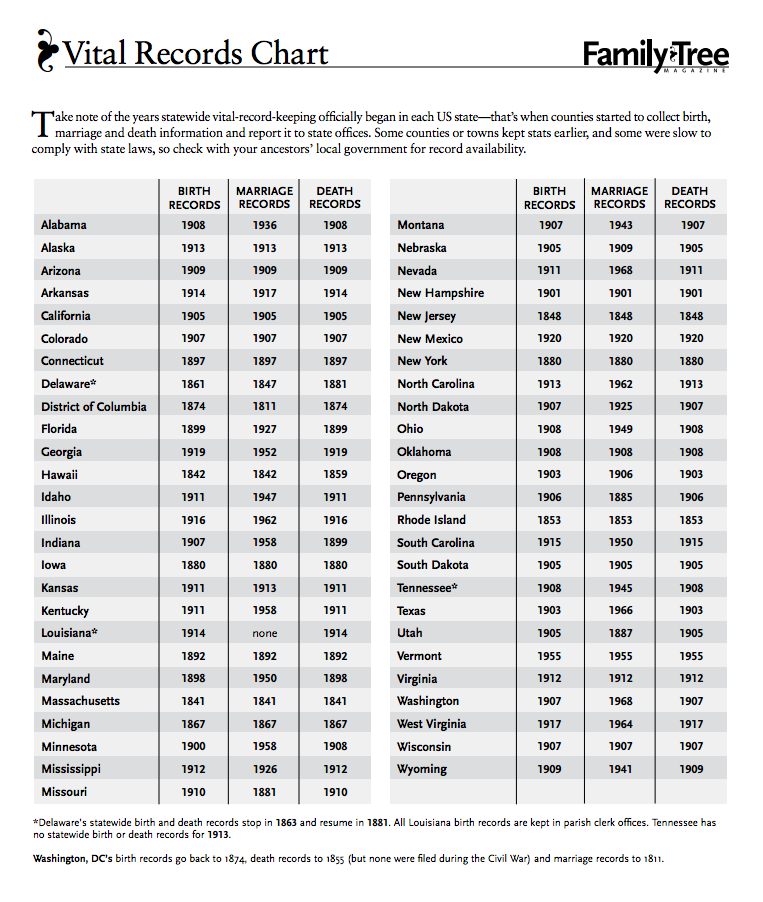
Family Tree Magazine's free Vital Records chart

Family Tree Magazine Vital Records Chart
Vital records are records of life events kept by the authority of a government. Birth certificates, marriage licenses, and death certificates are all considered vital records, and are excellent sources of information about our ancestors' lives. Each US state has laws governing the way vital records are collected and preserved.

Family Tree Magazine recently published a handy chart listing the beginning dates for official records in all 50 US states. The differences by state can be important to understand. For example, New Jersey began keeping official birth records in 1848, but Mississippi didn't begin until 1912. Indiana didn't begin recording marriages officially until 1958. If your ancestor was born in Mississippi in 1902 and married in Indiana in 1930, you will not be able to locate either a birth certificate or a marriage certificate. If she was born in New Jersey in 1850 and married in 1868, you should be able to get copies of both. Some (but not all) vital records for 48 of the 50 states are available digitally at FamilySearch.org.

Family Tree Magazine's Vital Records chart is available for free at familytreemagazine.com. Copies are also available in the Williamsburg (VA) Family History Center.

Friday, January 23, 2009

Family History Library Catalog

The Family History Library (FHL) in Salt Lake City is the largest library of its kind in the world. Many of the 2.4 million rolls of microfilm and 727,000 microfiche can be ordered through a local Family History Center so you can view them without making a trip to SLC (fun as that would be!). Learning to use the FHL Catalog is critical to finding out what resources are available that might have information about your family.

The FamilySearch team has recently released brief on-line
training videos that can help you learn to search the catalog quickly and effectively. To view the list of available lessons, go to the Family History Library Catalog page. You can search the catalog directly from there, or select one of the training videos to view.

Saturday, November 22, 2008

Finding Prussian Ancestors

Hundreds of thousands of marriage records from 19th century Catholic and Lutheran parishes in the Poznan (Posen) region of Prussia have been indexed by volunteers and are available for you to search at The Poznan Project website.

If you find your ancestor in the index, you then have the parish and can search the Family History Library Catalog at familysearch.org for additional information available on microfilm through your local Family History Center. 

Check the status of available records indexed to date, and more are being added as additional parishes are completed. This is a database to re-check periodically. Check out www.polishroots.org and the Poland page on the FamilySearch wiki to learn more about Polish and Prussian records.